

Sandeep Yadav
Deep Brain Stimulation


Cyberdyne technology that involves the use of a cyborg robot HAL (Hybrid Assistive Limb) was introduced in India by renowned Neuro and Spine Surgeon, Dr. Sachin Kandhari at IBS Hospital in November 2020. IBS Hospital has marked the beginning of Cyberdyne treatment in South Asia by laying the foundation of IBS Cybernix Centre, that aims at offering Advanced Neuro-Robotic Rehabilitation. Invented in Japan, Cyberdyne is the world’s first cyborg-type robot HAL (Hybrid Assistive Limb) that helps to rehabilitate, support and improve the wearer’s bodily functions by enhancing the motor learning capacity of their cerebral nerves through physical walking motions.
It is a revolutionary technology that can help physically challenged people to get back on their feet and enable them to exert more motor energy by providing positive feedback to their brain regarding the completion of the intended motion. Cyberdyne works by strengthening the signal pathways connecting the brain and the muscles, which gradually helps to facilitate independent motor functions.
 More Information

How Cyberdyne treatment works?
Lower limb disabilities are usually a result of cerebral or neuromuscular disorders, both of which prevent the brain from using ordinary neural pathways. Cyberdyne treatment helps to move the wearer’s limbs in accordance with the wearer’s intention. This is how technology works :
More Information

What is Hybrid Assistive Limb
HAL [Hybrid Assistive Limb] is the world‘s first cyborg-type robot, by which a wearer‘s bodily functions can be improved, supported and enhanced.
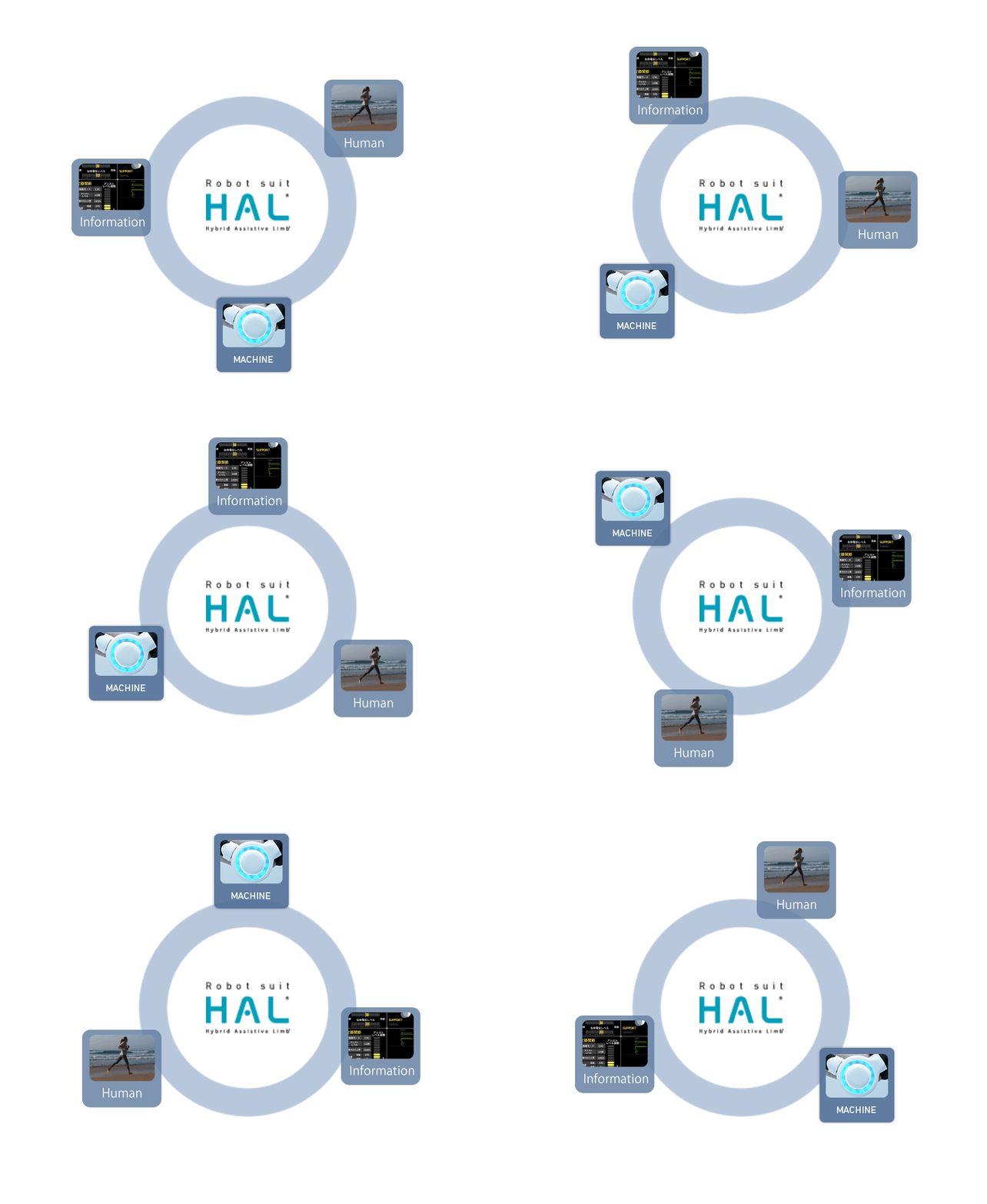
Wearing of HAL leads to a fusion of “man”, “machine” and “information”. HAL assists a physically challenged person to move and enables him or her to exert bigger motor energy than usual. HAL is also considered as the system that accelerates a motor learning of cerebral nerves.
More Information
HAL

Pablo

Tymo

Luna

Hand Of Hope

Physiotherapy
First of all, think “I want to walk!”
When a person moves the body, he or she first thinks about the motions in his or her brain.By thinking “I want to walk.” the brain transmits necessary signals to muscles necessary for the motions through nerves.

Receiving the signals, muscles move.
In the healthy body, each muscle is able to receive signals destined from the brain to it and move as strongly and fast as intended.
HAL reads signals.
Signals sent to muscles by the brain leak on the skin surface as very faint signals, so called “bio-electric signals [BES]”. HAL is able to read BES by only attaching the originally developed detectors on the surface on the wearer‘s skin. By consolidating various information, HAL recognizes what sorts of motions the wearer intends.
HAL moves as the wearer intends.
HAL, in accordance with the recognized motions, controls its power units.*2 This function enables HAL to assist the wearer‘s motions as he or she intends and exerts bigger power than he or she ordinarily exerts.
*2 HAL preforms assistance for the wearer‘s motions by a combination of Cybernic Voluntary Control [CVC] system, with which Robot Suit moves as the wearer intends by detecting BES, and Cybernic Autonomous Control [CAC] system, with which Robot Suit replicates human motions based on fundamental motion patterns in the absence of BES.This is the advanced technology on which HAL is founded.
The brain learns motions.
The mechanism to move the human body does not end up with only moving muscles. The brain confirms how the body moved on what sort of signals. When HAL has appropriately assisted the motions of “walking”, the feeling “I could walk!” is fed back to the brain. By this means, the brain becomes able to learn the way to emit necessary signals for “walking” gradually. This leads to “the important first step” in walking of the physically challenged person without being assisted by HAL. The only robot that can provide appropriate solutions for motions to the brain is HAL.

At IBS, we are committed to bringing the best technology from across the globe, for your care.
State of the art facilities offered here include:


Cyberdyne technology that involves the use of a cyborg robot HAL (Hybrid Assistive Limb) was introduced in India by renowned Neuro and Spine Surgeon, Dr. Sachin Kandhari at IBS Hospital in November 2020. IBS Hospital has marked the beginning of Cyberdyne treatment in South Asia by laying the foundation of IBS Cybernix Centre, that aims at offering Advanced Neuro-Robotic Rehabilitation. Invented in Japan, Cyberdyne is the world’s first cyborg-type robot HAL (Hybrid Assistive Limb) that helps to rehabilitate, support and improve the wearer’s bodily functions by enhancing the motor learning capacity of their cerebral nerves through physical walking motions.
More Information

Deep Brain Stimulation

Deep Brain Stimulation

Deep Brain Stimulation
Neurological problems can be debilitating but timely diagnosis and proper treatment can help you lead a better life. Here are some inspirational stories of our patients, who overcame their neuro problems with leading-edge solutions offered by IBS experts.
Get StartedMeet the team of highly specialised and experienced neurosurgeons, neurologists and other experts in the field of neurology and spine care. Our team is dedicated to providing personalised and compassionate care to each patient, with the goal of helping them achieve the best possible outcomes.


